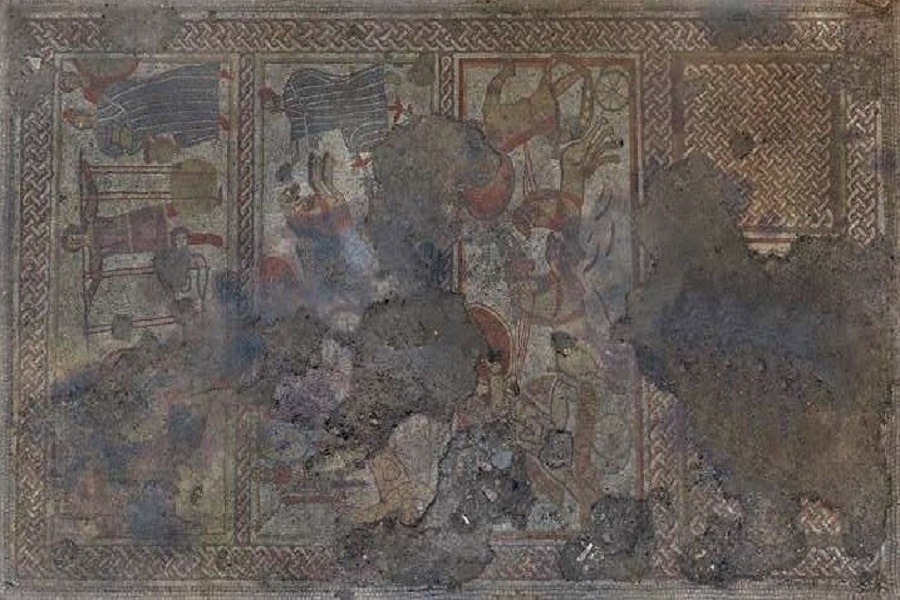
A high status Roman villa has been discovered between Ketton and Luffenham, close to the River Chater, south of Rutland Water. An excavation undertaken by the University of Leicester has uncovered part of a dramatic mosaic with 3 panels each portraying a scene from the Siege of Troy.
The landowner made an initial investigation after spotting interesting surface pottery and exploring Google satellite images. He called in the Leicestershire County archaeologist and this led rapidly to a professional excavation. It will feature in an edition of Digging for Britain to be screened in 2022. The following video about the Rutland Roman villa has been released by the University of Leicester.
It is believed that the site comprises the main villa building, bath house and agricultural buildings, as well as a probable Saxon aisled hall, all arranged within a large, ditched complex. Geophysical surveys suggest that the principal building may be a double portico/corridor-type villa, with rooms arranged around an internal courtyard or garden and linked structures projecting at each end.
Finds recovered from the site indicate that it was occupied from the mid or later third century until the late fourth century AD. There is also evidence for post-Roman activity.
The mosaic uncovered within the main villa measures approximately 7m by 11m. John Thomas, deputy director of ULAS and project manager has called it Britain’s
‘most exciting Roman mosaic discovery for a century’.
The Rutland mosaic is unique in the UK in featuring Achilles and his battle with Hector at the conclusion of the Trojan War; it is one of only a handful of examples from across Europe. It points to an estate owner keen to demonstrate wealth, Roman affiliation, and knowledge of classical literature. There is evidence that the mosaic had been repaired and that the room was subsequently used other purposes, with a hearth built on part of the floor. The excavations suggest that several other rooms within the Rutland Roman villa may have had mosaic floors.
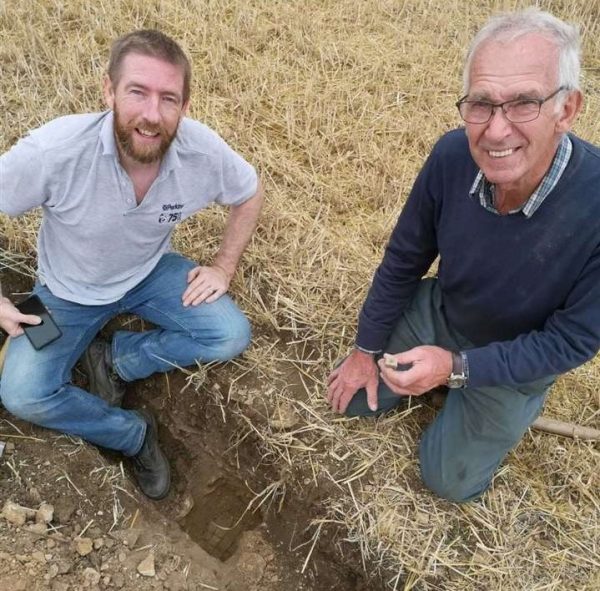
Jim Irvine and Brian Naylor discovered the Roman mosaic in their field during the 2020 lockdown
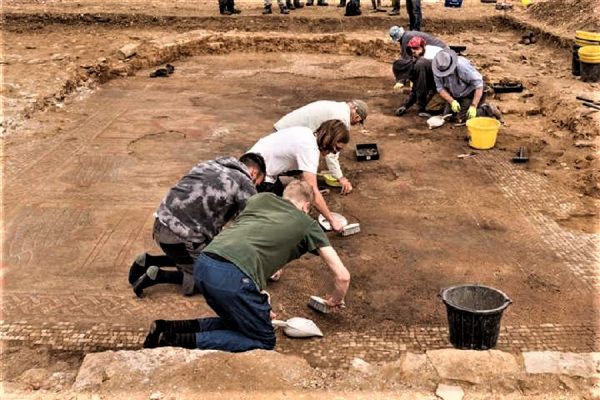
Exposing the mosaic floor
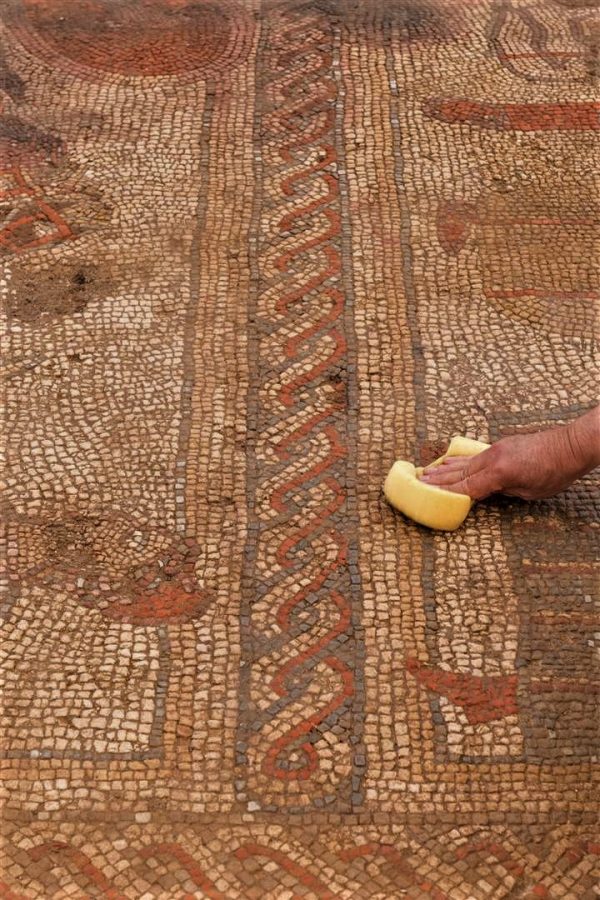
Cleaning reveals the intricate design and colourful images
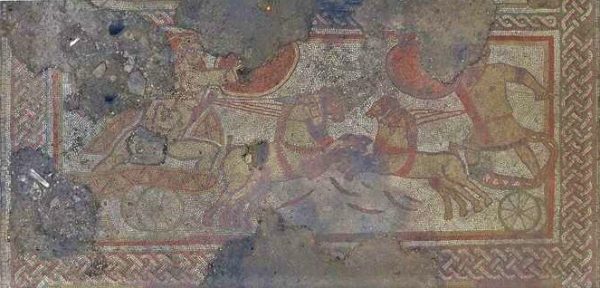
A scene depicting the battle between Achilles and Hector
The site near Cuckoo Lodge Farm sits within a meander of the River Chater – just south of the Peterborough-Birmingham railway line. It is close to the recently established Rutland Vineyard; perhaps the idea of a vineyard on rolling limestone slopes is not so new! Please note that the site has been added to the list of Scheduled Monuments and is on private land so is not accessible.
Historic England is planning further excavations for 2022.
Rutland Roman Villa – 2022 Update
The team from Leicester University and Historic England returned to the Rutland Roman Villa site this summer and were not disappointed. A series of trenches across the site were targeted to flesh out understanding of this high-status villa community discovered in 2020. Finds included another mosaic (a geometric design more familiar to those in the Nene Valley) and a large aisled hall.
Excavations in 2022 have revealed a large hall located 50 metres from the main villa. It was probably originally a wooden barn which was converted to stone during the 3rd or 4th century. One end of the structure was used for agricultural or craft work, while the other end was an extensive domestic area which had a bath suite, containing a hot (laconicum) and cold (frigidarium) rooms.
There is evidence of sophisticated underfloor heating that used different techniques to maintain varying temperatures and heating ducts built into the walls. It is thought that the floor of a water tank situated outside the building might have been used to collect water from the roof.
Focusing on the main villa, the team found fragments of polished marble, broken stone columns and painted wall plaster. Most notably is evidence of mosaics in the corridors leading to the dining room, one of which is relatively intact and features an intricate geometric pattern that probably dates to the same period of construction as the Trojan War mosaic.
The new finds suggest the estate was older than previously thought, possibly by a hundred years or more, meaning it was first occupied in the 2nd or 3rd centuries.
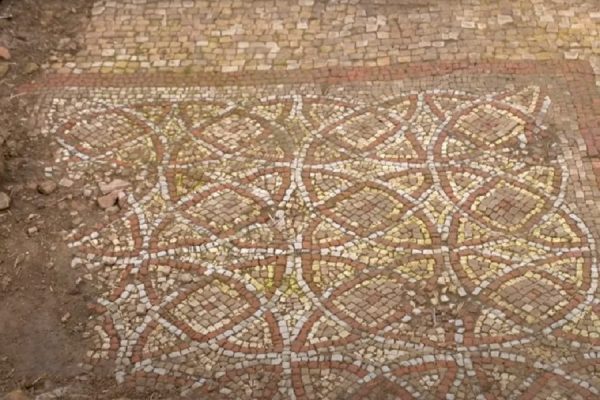
Mosaic with geometric design discovered in 2022
2022 Video Update from ULAS and Historic England
The Archaeological Context of the Ketton Roman Villa
Historic England undertook a survey in 2023 based on aerial images and lidar to help place the Rutland villa in a wider geographic and historical context. As well as addressing the immediate location of the villa, the area surveyed includes Ketton and Easton on the Hill and extends as far south as Duddington. It identifies many prehistoric features as well as those from the Roman period onwards – as such the report is a useful reference for others with a broader interest in the local archaeology.
The survey identifies a complex of ritual enclosures and barrows close to the River Welland dating from the Neolithic to the Iron Age. The prehistoric field systems show that the region was cleared of forest and established as open grassland by the Late Bronze Age. There is extensive evidence of quarrying taking place over thousands of years and continuing to this day. Medieval settlements emerge with well-preserved ridge and furrow field systems.
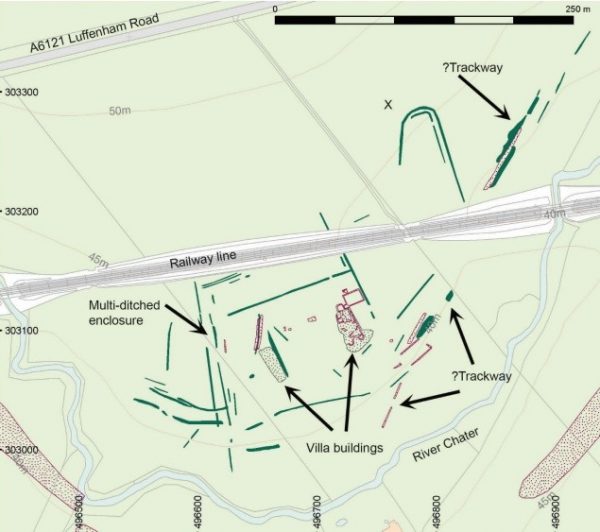
Traces of the Rutland Roman villa complex and surrounding features mapped from aerial photographs and lidar. The trackway may correspond with the speculated Roman road from Great Casterton heading southwest to cross the Welland at Tixover. Image Credit – Historic England
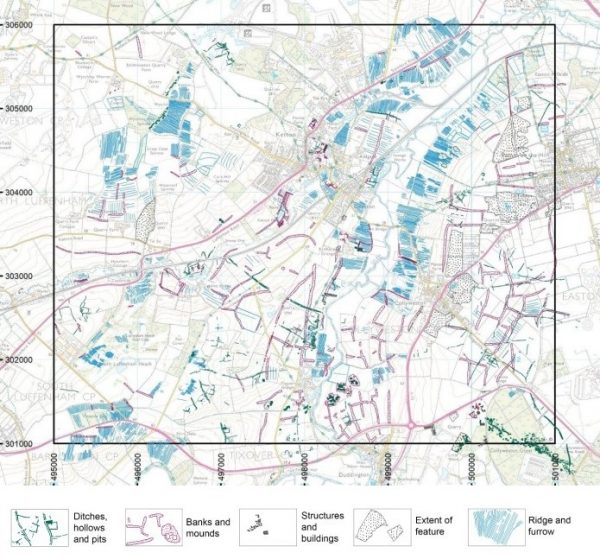
All mapped features recorded within the Rutland Villa Survey area. Image Credit – Historic England
What is the Source of the Ketton Mosaic Images?
New research from the University of Leicester has concluded that the mosaic does not depict scenes taken direct from Homer’s Iliad as was initially believed but instead, draws on an alternative version of the Trojan War story which was first popularised by the Greek playwright Aeschylus.
The mosaic’s images combine artistic patterns and designs that had been circulating for hundreds of years across the ancient Mediterranean, suggesting that craftsmen in Roman Britain were closely connected to the wider classical world.
Dr Jane Masséglia, lead author of this new research explains:
“In the Ketton Mosaic, not only have we got scenes telling the Aeschylus version of the story, but the top panel is actually based on a design used on a Greek pot that dates from the time of Aeschylus, 800 years before the mosaic was laid. Once I’d noticed the use of standard patterns in one panel, I found other parts of the mosaic were based on designs that we can see in much older silverware, coins and pottery, from Greece, Turkey, and Gaul.
Romano-British craftspeople weren’t isolated from the rest of the ancient world, but were part of this wider network of trades passing their pattern catalogues down the generations. At Ketton, we’ve got Roman British craftsmanship but a Mediterranean heritage of design.”
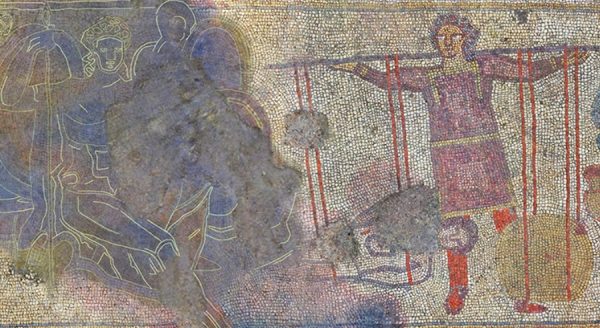
Panel 3 of the mosaic shows Priam, king of Troy, loading a set of scales with gold vessels, to match the weight of his son, Hector. This version of the story is based on the lost play, Phrygians by Aeschylus. Jen Browning from University of Leicester Archaeological Services was able to reconstruct the burnt section by tracing the outline of the tiles. Image Credit – ULAS